

Sales Leader France & Benelux. Responsible for IBM license sales and AEXIS solutions, from scoping to licensing, renewals, and software + services bundles.
AI in the enterprise becomes truly useful when it can act beyond the chat window. In an EPM environment, that means understanding a business need, accessing Planning Analytics objects, running a query, using a view, or triggering a targeted process according to context. This is precisely where the MCP model becomes strategic. By connecting watsonx Orchestrate to IBM Planning Analytics through an MCP server, the agent is no longer limited to a textual assistant role: it can rely on tools exposed in a structured way to interact with the TM1 environment. For AEXIS, this is a particularly strong direction because it brings agentic AI closer to real finance, controlling, and planning use cases.
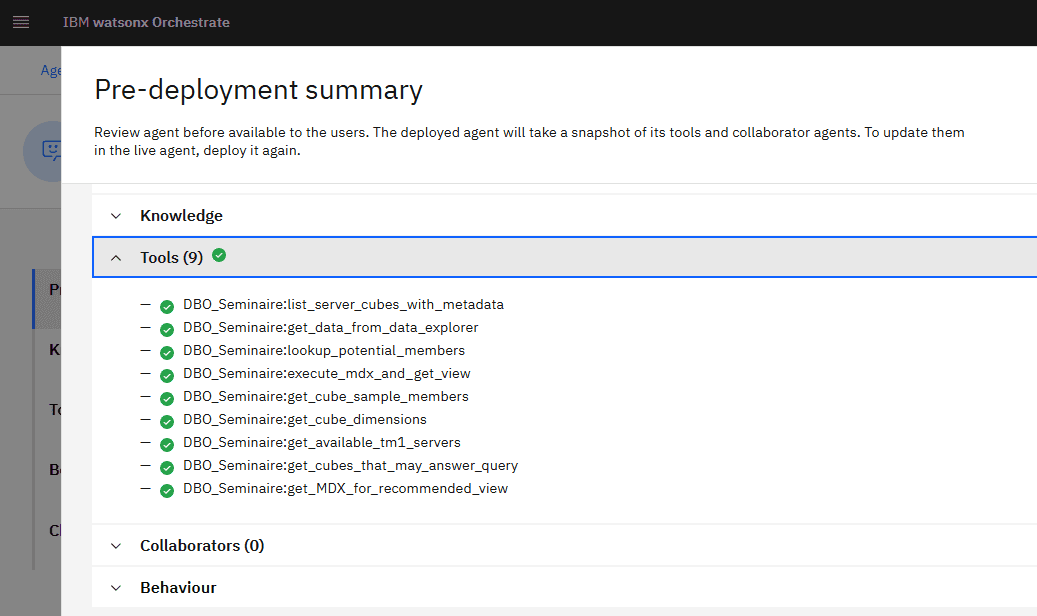
Why MCP changes the value of an AI agent
An agent without tools remains limited to explanation, summarization, or suggestion. As soon as it needs to interact with a business system, another layer becomes necessary: the layer that describes the available capabilities, their parameters, and how to call them within a structured framework.
The MCP server addresses this need precisely. It provides the agent with a clear access point to remote tools, allowing it to plan actions based on business intent without relying on improvised logic.
Connecting watsonx Orchestrate to Planning Analytics in an operational way
In the case of IBM Planning Analytics, this approach opens very concrete possibilities. An agent can be enhanced with MCP tools exposing analysis or manipulation capabilities related to the TM1 environment, depending on the scope chosen to be made accessible.
This makes it possible to move from a purely conversational use case to a tool-assisted one, where the agent can rely on functions that are genuinely connected to the planning platform. This makes the dialogue far more operational for business teams.
More credible use cases for finance and performance management
In a finance context, the real value is not that an agent explains what a cube is or what a view is. The value is that it helps find the right objects, launch the right analysis, contextualize a business request, or accelerate certain tasks around planning data.
This logic can serve as a foundation for specialized assistants dedicated to analysis preparation, Planning Analytics user support, operational documentation, TM1 structure exploration, or guided execution of controlled processes.
A good Planning Analytics agent does not rely only on the LLM
This type of architecture highlights an essential point: the value of an agent does not depend only on the model being used. It depends above all on the quality of the connected tools, the granted action scope, the defined guardrails, and the business understanding embedded in its design.
In other words, an agent connected to Planning Analytics through MCP must be designed as a governed component of the information system, not as a simple conversational interface connected in haste.
Why AEXIS is legitimate on this topic
AEXIS understands both IBM Planning Analytics challenges and the realities of enterprise industrialization. This is a key point to avoid attractive experiments that are difficult to sustain over time.
Our approach is to identify the use cases where an agent connected to Planning Analytics can create real value, then properly frame access, tools, validations, and the deployment path. It is this combination of EPM expertise and AI integration that gives strength to an initiative built around watsonx Orchestrate and the MCP model.